When spring arrives and cherry blossoms bloom, many Japanese people crave “sakura mochi,” a representative spring wagashi. It’s a classic spring treat, and seeing it in stores signifies the arrival of spring.
Sakura mochi is enjoyed nationwide, but did you know there are actually two types of this confectionery?
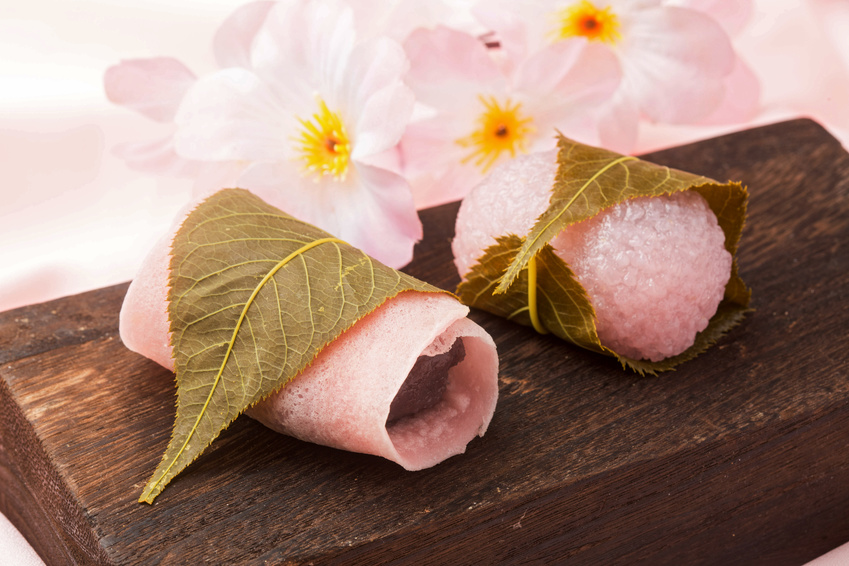
One is the Kanto-style sakura mochi, originating from Tokyo. And the other is the Kansai-style sakura mochi, originating from Osaka.
Aside from both being wrapped in salted cherry leaves, their ingredients and shapes are completely different.
How did these two types of sakura mochi come about? Let’s explore the history of sakura mochi!
Origin of Kanto-style Sakura Mochi
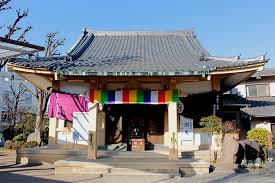
The origin of sakura mochi is said to be in the Kanto region. Kanto-style sakura mochi, also known as “Chomeiji” or “Chomeiji mochi,” is from Chomeiji, a temple in Sumida Ward, Tokyo.
A man named Shinsuke Yamamoto, who was the gatekeeper at Chomeiji Temple, used to clean around the temple. The area was famous for cherry blossoms, with many cherry trees planted, resulting in a large amount of fallen cherry leaves. He pondered how to make use of these leaves and decided to try pickling them in salt. Surprisingly, the salted cherry leaves emitted a pleasant fragrance. He then wrapped these leaves around mochi and offered them to temple visitors, becoming an instant hit. Sakura mochi gained unexpected popularity, selling rapidly and spreading from Mukojima to all over Japan. Kanto’s sakura mochi came to be known as “Chomeiji sakura mochi” due to its origin at Chomeiji Temple.
Beginnings of Kansai-style Sakura Mochi
Kansai-style sakura mochi is said to have been inspired by the popular Chomeiji sakura mochi from in Edo (Old Tokyo).
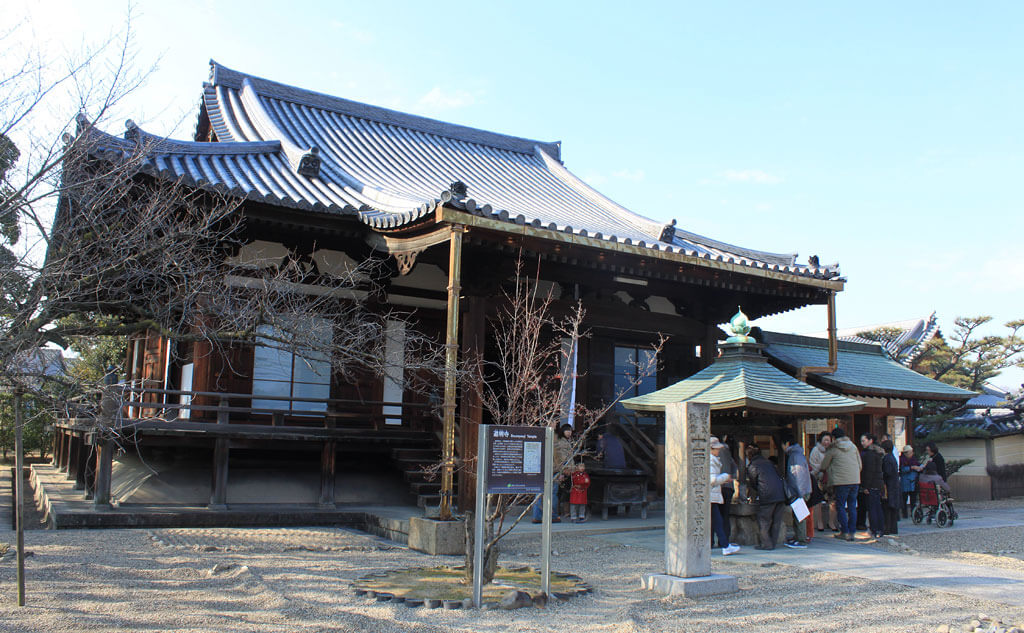
Wagashi shops in Osaka thought about creating a confectionery similar to the popular sakura mochi in Kanto and created sakura mochi using “do-myoji-ko” (glutinous rice flour).
Do-myoji-ko is made by steaming and drying glutinous rice, then coarsely grinding it. It is commonly used in Japanese confectioneries. It was first made over 1000 years ago at Do-myoji Temple in Fujiidera City, Osaka, and was highly valued as a non-perishable food item. The sakura mochi made using this was named “Do-myoji sakura mochi” due to its use of do-myoji-ko.
Characteristics of the Two Types of Sakura Mochi
Even though they are both called sakura mochi, there are significant differences between Kanto-style and Kansai-style, both in appearance and texture.
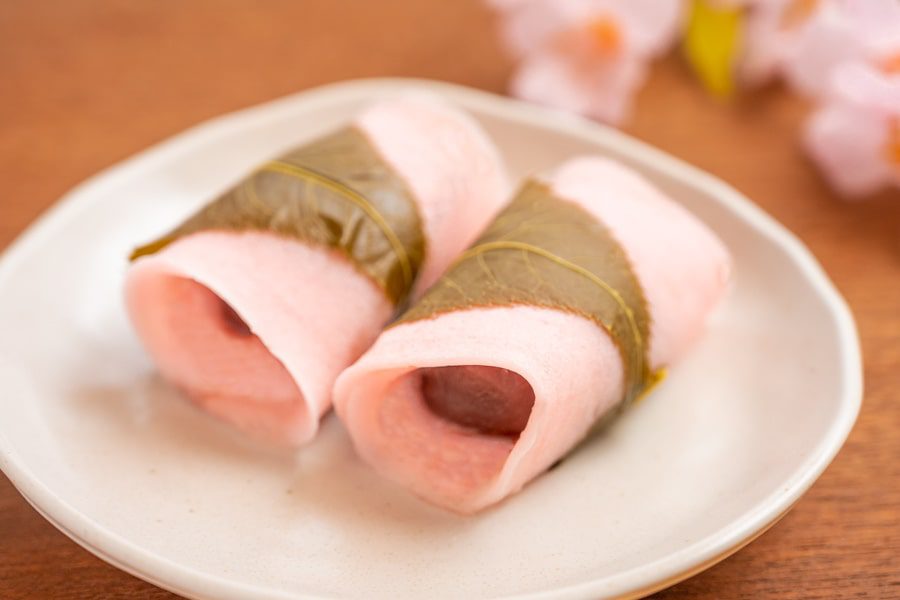
Kanto-style sakura mochi from Chomeiji uses crepe-like dough made with wheat flour, wrapped around sweet bean paste (anko) and then wrapped with salted cherry leaves. Depending on the shop, there are variations in shapes, such as wrapping the dough baked into a tube shape or folding it in half.
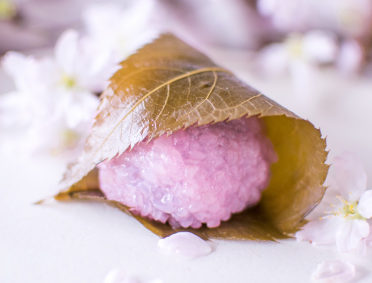
Kansai-style sakura mochi made with do-myoji-ko is wrapped around sweet bean paste, formed into a round shape, and finally wrapped with one salted cherry leaf. The base of do-myoji-ko, which is made from glutinous rice, gives it a chewy texture. Additionally, the size of the glutinous rice affects the texture, varying slightly depending on the maker and region.
Benefits of Cherry Leaves
The unique fragrance of sakura mochi comes from a component called coumarin found in cherry leaves. Fresh cherry leaves themselves have little aroma, but pickling them in salt brings out their fragrance.
Cherry leaves are used not only for their rich aroma but also for another reason: their antioxidant properties. Any food item tends to lose its flavor when oxidized, but cherry leaves help slow down the oxidation of the dough, preserving its deliciousness. Additionally, wrapping the dough with cherry leaves helps prevent moisture loss. Despite being just a leaf, it is used for a significant reason.
How about that? I’ve summarized some interesting points about sakura mochi. It’s fascinating to discover the background behind a treat we often enjoy. Lastly, I’ll share my own experience with sakura mochi. Having grown up in Osaka, I was only familiar with Do-myoji sakura mochi, and it wasn’t until I attended wagashi school that I learned about Kanto-style sakura mochi. During a class on sakura mochi, I was completely bewildered because the sakura mochi being taught was completely different from what I had in mind. I thought, “What is this!? Is this sakura mochi? Where’s the mochi? It looks like a crepe… Wait, this is Tokyo’s sakura mochi?!” It was my first cultural shock experience in Tokyo! There are many such regional differences when it comes to traditional Japanese sweets, and exploring these differences is quite interesting. If given the chance, I’d love to introduce more differences between Kanto and Kansai wagashi.
Well then, everyone, enjoy the cherry blossom season while indulging in some sakura mochi!
 | 返信転送リアクションを追加 |